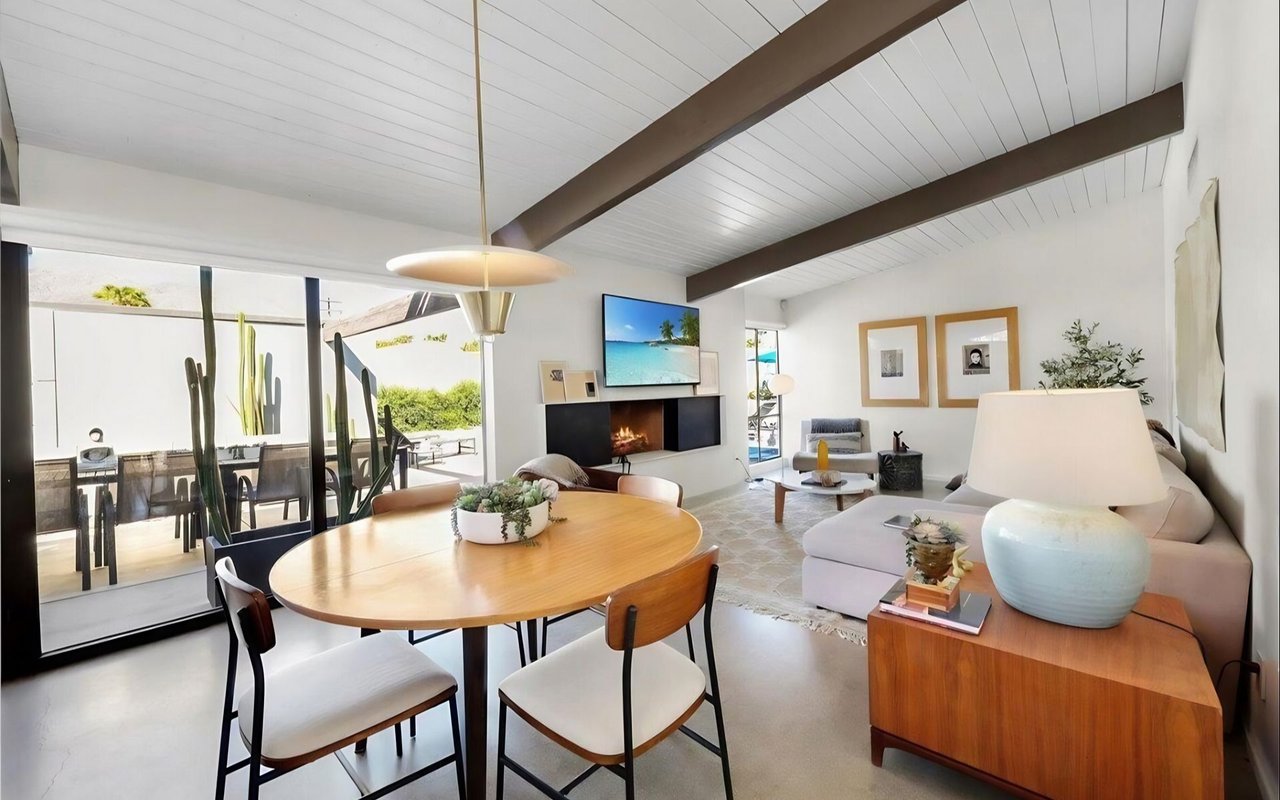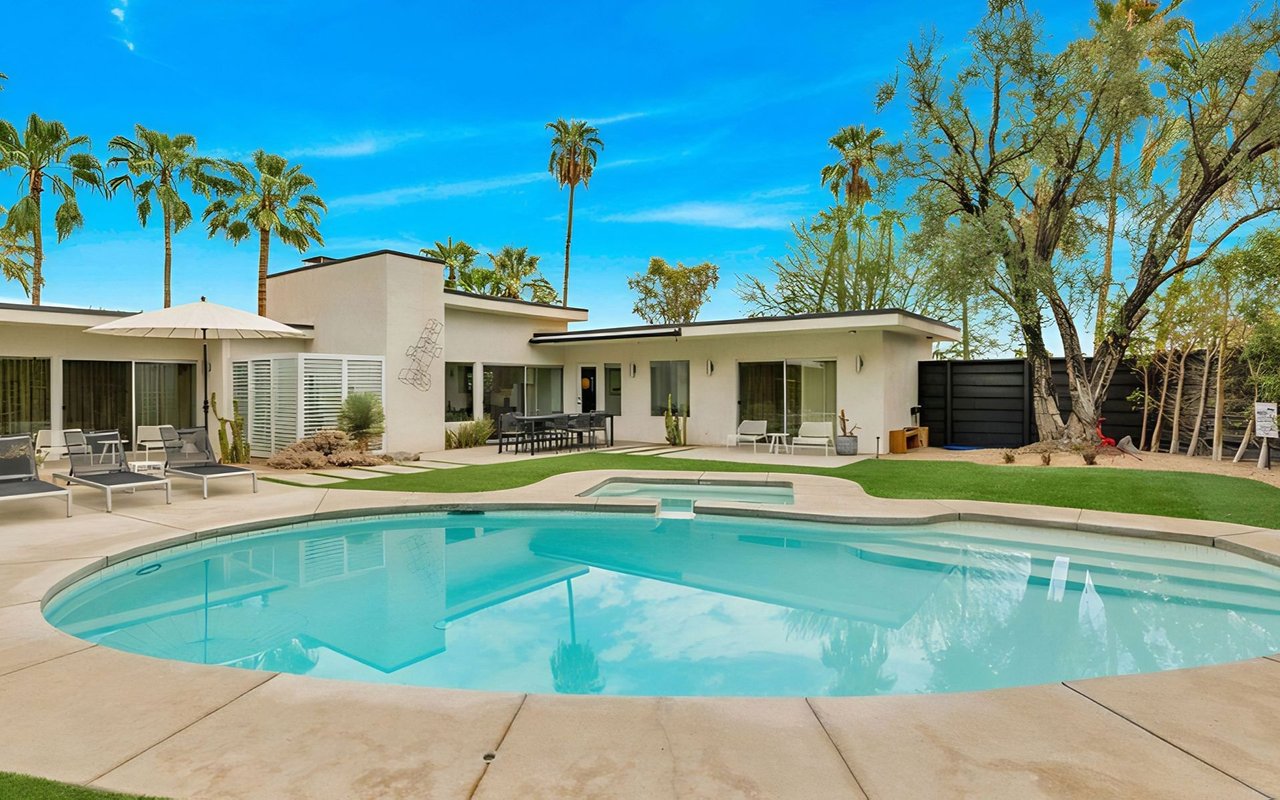
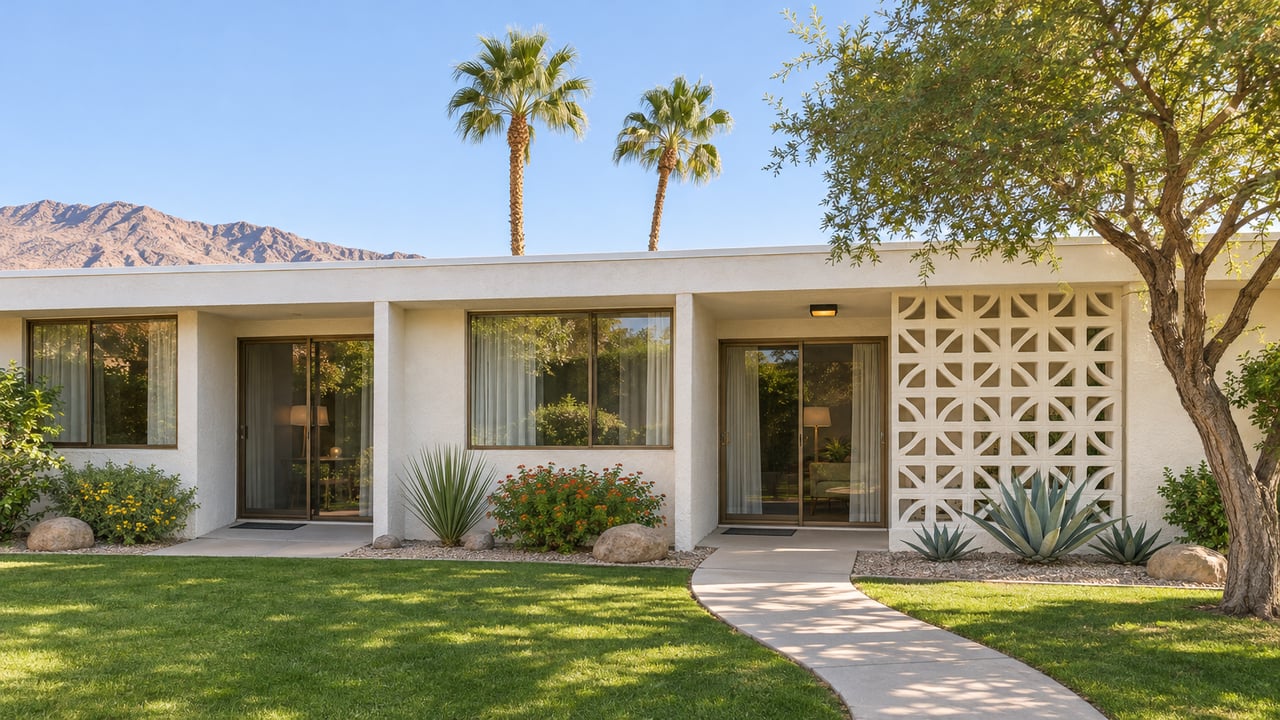
Ocotillo Lodge began as a hotel where people shopping for Twin Palms houses could stay while they decided. Each room was built like the homes for sale, with tongue-and-groove ceilings, clerestory windows and glass walls opening to a private patio. Gene Autry bought it in 1963 and put up his California Angels there during spring training. Jerry Buss owned it from 1968 to 1990, and the Lakers stayed there too. Between 1990 and 1995 it changed hands three times. Then an investment company split it into condominiums, and a unit sold for about $36,000.
In 2023 the owners' association was due to repaint. It worked with Architectural Resources Group on paint research and returned the complex to its original colors. In 2024 the old sign needed repair. Replacing it cost only slightly more, so the association put up an exact replica of the 1957 sign, set in a font William Krisel designed. Canyon Signs built it, and a grant from the Twin Palms Neighborhood Organization helped pay for it.
Every mid-century condo complex in Palm Springs comes with a famous architect's name. A more useful way to compare them is what each association has spent to keep that architect's work intact. Here, that restoration history is on public record, and this year's market gives buyers time to read it.
Where Palm Springs condo prices sit this fall
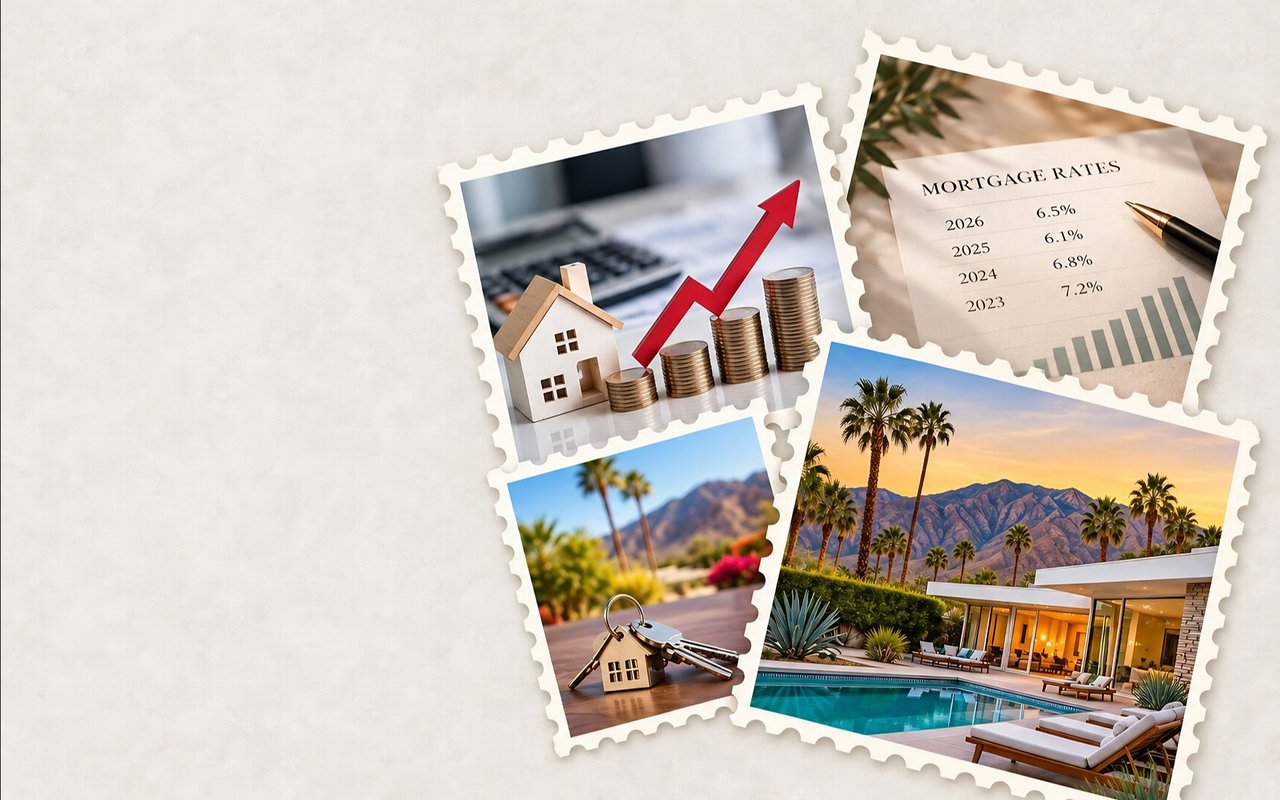
Greater Palm Springs REALTORS® publishes a monthly Desert Housing Report, and the Palm Springs Tribune covered the September 2026 edition. In that report, a typical 1,250-square-foot attached home in Palm Springs was estimated at $425,614. That is down 0.7% from September 2025 and 11.3% below the 2022 peak. A typical 2,175-square-foot detached house was estimated at $1,102,246, which is 22.3% below its own 2022 peak. These are standardized estimates built from median price per square foot. They are not median sale prices, and they cover the 92262 and 92264 ZIP codes citywide.
So since 2022, Palm Springs condos and townhomes have lost about half as much value as houses. The market is also giving buyers room to negotiate. In GPSR's September figures, Palm Springs homes sold for an average of about 4.3% below final list price, and the median home spent 55 days on the market, down from 61 a year earlier. In the same report, the Tribune noted that updated, well-maintained homes priced close to recent comparable sales may keep drawing interest, while homes that need major renovation may struggle.
If the market is rewarding well-kept property, a complex's restoration record tells you a lot about what you are buying into. Palm Springs has an unusually clear version of that record, because these associations have spent the past 16 years seeking historic designation one complex at a time. Taking them in the order they were designated shows how that record has grown.
2010: Royal Hawaiian Estates went first
Royal Hawaiian Estates sits at 1774 South Palm Canyon Drive. Wexler & Harrison designed it in 1960. It has 40 units in 12 buildings on five acres, with Polynesian-modern details such as tiki apexes and the angled roof supports known as "flying sevens." On February 3, 2010, the Palm Springs City Council made it the city's first residential historic district.
The work kept going after designation. Some of the tiki apexes had gone missing over the decades, and the HOA installed the sixth and final replacement in May 2011, with grant support from the Palm Springs Preservation Foundation. If you want the most playful roofline among the city's mid-century condos, this is the one. The owners have more than 15 years of documented work bringing it back.
2013: Racquet Club Cottages West
Racquet Club Cottages West is at 360 West Cabrillo Road, next to the old Racquet Club. William F. Cody designed it, Paul Trousdale developed it, and it was built in 1959 and 1960. Phil Shipley and Associates designed the grounds. Today the complex has 37 condominiums, down from 54 units originally, and the City Council designated it a historic district on November 20, 2013. It is one of the few chances to own a Cody design in a condo building, in the north end's tennis-club setting. For a sense of that part of town, see our Racquet Club Estates page.
2016: Park Imperial South, and a different kind of record at Canyon View Estates
Park Imperial South was built in 1960 on 3.5 acres with views of the San Jacinto Mountains. All 30 units share one 1,426-square-foot floor plan, with a folded-plate roof, decorative concrete block, a terrazzo runway from the front door to the patio, and shoji screens dividing the rooms. Barry Berkus designed it at 25. A father-and-son team built it and sold the units under the name "Trudy Richards," an invented persona combining the first names of Richard L. Weiss and his wife, Trudy. A Trudy Richards ceramic tile still marks the entrance to each unit. The folded roof plates are made of stressed-skin wood and rest only on the perimeter walls, so the interiors open up with no posts.
The HOA completed a demonstration restoration of a concrete-block wall in November 2011. By August 2014, according to the HOA, the project had led owners to restore the walls at three more units. City records show the council approved the historic-site designation on October 5, 2016. Because every unit shares the same plan, the restored wall shows each owner what their own wall can look like.
Canyon View Estates shows a different kind of care. Palmer & Krisel designed it for developer Roy Fey, and construction began in phases in 1962 at South Sierra Madre and East Canyon Vista Drive. The original plan called for 225 units. Removing 45 of them left the complex with a park-like setting. In 2016, a preservation grant supported by the HOA helped switch the landscape lighting to LEDs and pay for xeriscaping. Here the open space is part of the original design, and the 2016 work went into keeping the grounds up.
2024: Ocotillo Lodge
The paint and sign work at the start of this post came just before designation. The city designated Ocotillo Lodge a historic district on May 23, 2024, with Palmer and Krisel listed as architects and the Alexander Construction Company as builder. The Twin Palms Neighborhood Organization covered the February 5, 2024 dedication of two restored entry signs and reported that owners paid the balance of the project after donations and grants. The association has said it hopes to restore the original restaurant as an event center. The kitchen equipment is gone, so it can't be a restaurant again. This past March, the HOA's news page listed a Modernism Week feature on Ocotillo Lodge tours and preservation talks.
Ocotillo Lodge has the closest tie to a single-family neighborhood of any complex here. It was built as the hotel for Twin Palms, it sits on Twin Palms' northern edge along East Palm Canyon Drive, and that neighborhood organization helped pay for its sign. See our Ocotillo Lodge page for more on the complex.
2026: Sagewood becomes the 13th
The newest designation came this year. The Palm Springs Preservation Foundation describes Sagewood, at North Sunrise Way and Vista Chino, as 107 one-story homes in 27 separate four-unit buildings on 18 acres. Levitt & Sons of California developed it and opened it in 1972. Donald Wexler designed it, and the Palm Springs Preservation Foundation calls it one of his few multi-housing projects and, by some accounts, his finest. It has two- and three-bedroom plans, three pools, a tennis court and a large greenbelt, and the nomination describes the land as fee simple.
The process took several years. Sagewood homeowner Claude Peck began preparing the nomination with PSPF board member Steven Keylon in December 2022. PSPF submitted the 111-page nomination for the owners on April 24, 2025. The Historic Site Preservation Board voted 6-0 in favor on January 6, 2026, and the City Council approved it unanimously on May 12, 2026. Sagewood is the city's 13th residential historic district.
The early designations went to small, well-known complexes. Sagewood is a 1970s project with more than a hundred homes, and its owners carried the nomination themselves. Mid-century condo buyers can now find documented preservation work across a wider range of complexes, from Royal Hawaiian's 40 units of 1960 to Sagewood's 1972 homes.
Questions to bring to any complex
Historic designation is one part of the record. What a buyer can actually read is the history behind it. Ask the association what restoration projects it has finished, who did the work and how owners paid for it. Every complex above has an answer on file. At Ocotillo, it's the Architectural Resources Group paint study and the owner-funded sign. At Royal Hawaiian, it's the tiki apexes. At Park Imperial South, it's the wall that led to three more restorations.
Next, ask what is planned. Ocotillo Lodge has made its restaurant restoration public. For any complex, a planned project can tell you as much as finished ones, because owners share the cost of what comes next.
Finally, compare what the association's work protects with how you want to live. Park Imperial South's 30 identical units, with one central pool and spa, will feel very different from Sagewood's 18 acres with three pools. A restored roofline means more to you if that roofline is why you came. Our mid-century neighborhoods guide gives the single-family context around several of these complexes, and our buyer's guide covers the steps from first tour to closing.
At The Paul Kaplan Group, we'd be glad to tour these complexes with you, from the replica of Krisel's 1957 sign at Ocotillo Lodge to Wexler's 1972 greenbelt at Sagewood, and to help you read each association's restoration history before you make an offer. If a mid-century condo is your way into Palm Springs, contact us and we'll help you compare the complexes on your list.